Choosing the right medical path to treat thinning hair can feel overwhelming when standard solutions fall short. Many adults look beyond basic retail options toward stronger, clinically backed alternatives to halt their hair loss.
The prescription medication dutasteride for hair loss is a highly potent 5-alpha-reductase inhibitor that stops testosterone from converting into dihydrotestosterone (DHT), the hormone mainly responsible for male and female pattern baldness. While it is FDA-approved to treat prostate enlargement, doctors frequently prescribe it off-label to combat thinning hair. Clinical studies show that dutasteride can lower serum DHT levels by about 98 percent, significantly more than the 71 percent reduction typically achieved by finasteride. By blocking both type 1 and type 2 enzymes, this treatment provides powerful follicular protection to help reverse miniaturization and support lasting hair growth.
Start My Plan — Get a personalized prescription for dutasteride today
To understand why this medication offers a distinct approach to managing pattern baldness, it helps to start with the biological mechanism that sets it apart from older, more widely prescribed treatments.
Dutasteride For Hair Loss: How Does Dutasteride Work for Hair Loss?
Dutasteride is a dual-action 5-alpha-reductase inhibitor that blocks both type 1 and type 2 enzymes, which suppresses DHT production more completely than finasteride and protects hair follicles from continued miniaturization.
Both dutasteride and finasteride belong to a class of drugs called 5-alpha-reductase inhibitors, but they differ in a critical way. The enzyme 5-alpha-reductase (5-AR) exists in two main forms: type 1 and type 2. Finasteride only blocks the type 2 enzyme, while dutasteride inhibits both type 1 and type 2. This broader enzyme coverage is the fundamental difference that drives many of the clinical advantages seen with dutasteride.
By inhibiting both forms of 5-AR, dutasteride achieves more complete suppression of DHT, the androgen responsible for follicle miniaturization in genetically susceptible individuals. According to the International Society of Hair Restoration Surgery, dutasteride lowers serum DHT by up to 98 percent compared to approximately 71 percent for finasteride. This additional 27 percent reduction can make a meaningful difference for patients whose hair loss continues despite standard finasteride therapy.

The pharmacokinetic profile of dutasteride is also distinct. Dutasteride has a half-life of approximately five weeks, compared to finasteride's half-life of just 6 to 8 hours. This means dutasteride remains active in the body much longer, providing sustained DHT suppression even if a dose is missed. However, it also means that any side effects that develop may take longer to resolve after the medication is discontinued.
At the molecular level, dutasteride is approximately three times more potent than finasteride at inhibiting the type 2 enzyme and more than 100 times more potent at inhibiting the type 1 enzyme. This potency difference, combined with dual enzyme coverage, makes dutasteride one of the most effective oral options for DHT suppression available today. Understanding the role of DHT in pattern hair loss helps clarify why this broader enzyme inhibition can translate to better clinical outcomes.
What Does the Clinical Evidence Say About Dutasteride?
Clinical trials consistently demonstrate that dutasteride outperforms finasteride in hair count improvement while maintaining a comparable safety profile, making it a strong evidence-based option for male pattern hair loss.
When choosing a treatment, clinical trial data can help guide your decision. Multiple large-scale medical trials show that DHT inhibition treatments like oral dutasteride are highly effective for treating male pattern hair loss. Researchers have studied how the drug compares to older, standard treatments across different dosages, delivery methods, and patient populations. The evidence consistently demonstrates that dutasteride offers advantages over finasteride in terms of hair count improvement while maintaining a comparable safety profile.
The Landmark 24-Week Comparative Trial
One major randomized trial published in the Journal of the American Academy of Dermatology (JAAD) evaluated 416 men aged 21 to 45 years with mild to moderate male pattern hair loss. The study compared five different treatment arms: dutasteride at doses of 0.05 mg, 0.1 mg, 0.5 mg, and 2.5 mg, alongside finasteride 5 mg and a placebo group. All participants received their assigned treatment daily for 24 weeks. By the end of the study period, the men taking 0.5 mg of oral dutasteride showed a statistically significant increase in target area hair count compared to both the finasteride and placebo groups. The results demonstrated that 0.5 mg of oral dutasteride was superior to finasteride 5 mg at promoting visible hair regrowth.
A 600-Patient Real-World Comparison
A large, multicenter retrospective medical chart review analyzed 600 male patients with androgenetic alopecia treated at clinics across South Korea. The study compared a daily oral dose of 0.5 mg of dutasteride to a standard daily oral dose of 1 mg of finasteride. The clinical review found that dutasteride for hair loss was superior at improving hair growth based on physician-assessed photographic evaluations. Crucially, the two patient groups showed very similar rates of adverse events, suggesting that the additional DHT suppression achieved with dutasteride does not come at the cost of increased side effects in real-world settings.
Topical Dutasteride and Combined Therapy
Some patients prefer to avoid systemic oral medications due to concerns about side effects or drug interactions. A 2022 randomized, double-blind, placebo-controlled trial tested a 0.01 percent topical dutasteride solution combined with microneedling. The active treatment group received weekly microneedling sessions plus daily topical dutasteride application, while the control group received microneedling with a saline solution. The study group using topical dutasteride showed a clear, measurable improvement in hair density and hair count compared to the saline group. Using a compounded topical dutasteride option may help limit systemic absorption while still delivering meaningful follicle protection. For patients exploring broader options, combination therapy with multiple active ingredients can target hair loss through several biological pathways simultaneously.
Hair Count at Week 24
Another randomized placebo-controlled clinical trial specifically evaluated oral dutasteride 0.5 mg in men aged 20 to 50 years with androgenetic alopecia. The results showed that dutasteride 0.5 mg significantly increased hair count at week 24 compared with both finasteride 1 mg and placebo. The hair count improvements were visible on standardized photographic assessments and confirmed through objective hair counts, providing strong evidence that dutasteride's more complete DHT suppression translates directly to measurable clinical benefits. You can review a typical hair growth timeline to understand what results to expect at each stage of treatment.
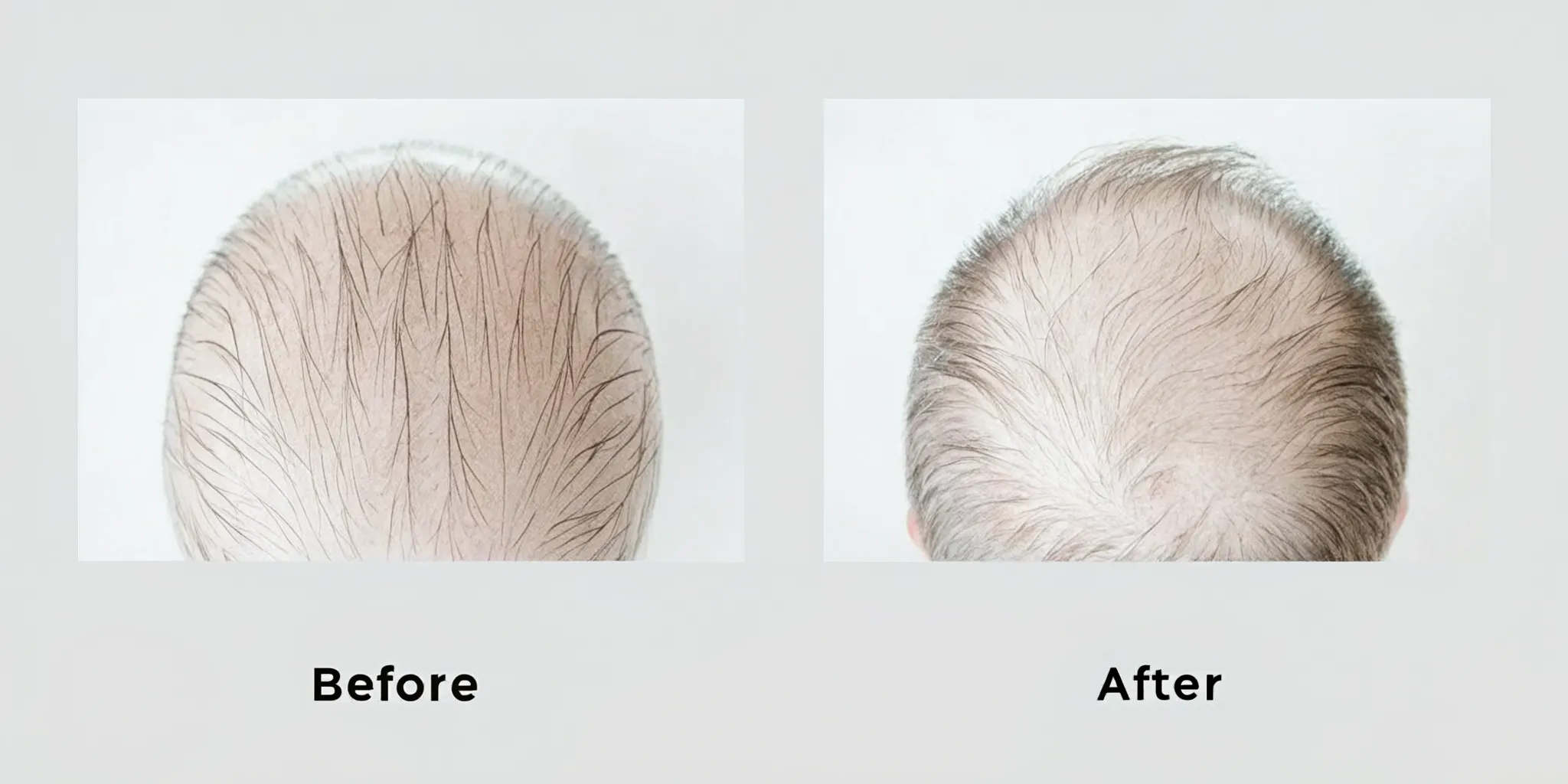
Dutasteride vs Finasteride: Key Differences at a Glance
The two 5-alpha-reductase inhibitors differ in enzyme coverage, DHT suppression, half-life, and FDA approval status, which directly affects how each drug is used in clinical practice for hair restoration.
For patients weighing their options between these two 5-alpha-reductase inhibitors, understanding the specific differences can help inform the decision. While both drugs target the same biological pathway, their pharmacological profiles differ in several important ways that affect efficacy, dosing, and clinical application.
| Characteristic | Dutasteride | Finasteride |
|---|---|---|
| Enzyme inhibition | Type 1 and type 2 5-AR | Type 2 5-AR only |
| Serum DHT reduction | ~90 to 98 percent | ~70 to 71 percent |
| Half-life | ~5 weeks | ~6 to 8 hours |
| FDA approval for hair loss | Off-label (approved for BPH) | FDA-approved (1 mg) |
| Relative potency (type II) | 3 times more potent | Baseline |
| Standard hair loss dosing | 0.5 mg daily | 1 mg daily |
| Time to steady state | ~6 months | ~1 to 2 days |
These pharmacological differences have practical implications:
- The longer half-life means dutasteride accumulates gradually in the body over months rather than days, and patients should expect a longer washout period if they decide to stop treatment.
- The broader enzyme inhibition may make dutasteride particularly suitable for patients who do not respond adequately to finasteride alone.
- The similar side effect profile means that tolerability does not need to be a deciding factor for most patients.
Is Dutasteride Safe? Understanding the Side Effects
Dutasteride has a well-documented safety profile based on years of clinical use for BPH and growing evidence for off-label hair loss treatment, with side effect rates comparable to finasteride in head-to-head studies.
Safety is a primary concern for anyone considering a prescription medication for hair loss, particularly one used off-label. Dutasteride carries a well-documented safety profile based on years of clinical use for benign prostatic hyperplasia and growing evidence for its off-label use in hair restoration.
The most commonly reported side effects of 5-alpha-reductase inhibitors include decreased libido, erectile dysfunction, and changes in ejaculation. In head-to-head clinical studies, the rate and severity of these sexual side effects were similar between dutasteride and finasteride. The 600-patient multicenter chart review specifically noted comparable adverse event rates between the two drugs, suggesting that the additional DHT suppression does not translate to a worse tolerability profile.
One important consideration specific to dutasteride is its long half-life. Because the drug remains active in the body for approximately five weeks after the last dose, any side effects that develop may take longer to resolve after discontinuation compared to finasteride. Patients should be aware of this distinction when deciding between the two medications.
There has been historical concern about whether 5-alpha-reductase inhibitors increase the risk of high-grade prostate cancer. Current evidence does not support a causal link, and the FDA labeling reflects this nuanced risk profile. Dutasteride is not approved for use in women who are pregnant or may become pregnant due to the risk of birth defects in a male fetus. For more details, review the safety information for prescription hair loss treatments.
All patients considering dutasteride for hair loss should undergo a medical evaluation to confirm that the medication is appropriate for their health status. Because dutasteride is used off-label for hair loss, a licensed provider must assess whether the potential benefits outweigh the risks for each individual. Common questions about prescription hair loss treatment can help you prepare for that consultation.
Getting Dutasteride Through Prescribed Essence
Prescribed Essence offers custom compounded treatments that combine dutasteride with other active ingredients in a single prescription tailored to your unique hair loss pattern and medical profile.
If you want to use dutasteride for hair loss, you do not have to rely on standard retail products or settle for a one-size-fits-all approach. Prescribed Essence provides custom compounded solutions that fit your specific hair loss pattern, medical history, and treatment goals. Our team of medical professionals works with you to design a plan that targets your hair loss with clinical precision and ongoing support.
The Benefits of Compounded Care
Most retail stores sell hair products formulated for a generalized consumer, with fixed doses and single active ingredients. Your hair loss pattern is unique to your genetics, hormone levels, and lifestyle. Through Prescribed Essence, you can access compounded topical dutasteride and oral options that are customized specifically for you. Our licensed pharmacists freshly compound each prescription in a specialized laboratory, ensuring potency, stability, and quality control. These custom formulas can blend 3 to 8 active ingredients into one convenient daily treatment. This means you can combine dutasteride for hair loss with other proven compounds like minoxidil, finasteride, or prostaglandin analogs in a single application. By addressing multiple biological pathways at once, you get a comprehensive treatment approach that packaged retail products simply cannot match. Explore the full range of available compounded formulas to see what combinations are possible.
The Online Consultation Process
Starting your personalized plan begins with a secure online medical consultation. This telehealth process is straightforward and designed to fit into your schedule.
- Complete a health assessment covering your hair loss history, family patterns, current medications, and overall health status.
- A licensed medical provider will review your file to confirm that dutasteride is both safe and appropriate for your specific needs.
- Your provider will select the optimal dose and combination of active ingredients for your hair loss pattern.
- Your personal health information is protected through HIPAA-compliant systems.
- Your custom compounded prescription is shipped directly to your door in discreet, unmarked packaging.
Ongoing Support and Formula Adjustments
Our care does not stop when your first package arrives. Hair growth is a gradual process, and your body's response to treatment can change over time. To keep your progress on track, Prescribed Essence provides ongoing clinical monitoring with regular check-ins and progress assessments. Your provider can evaluate your response to treatment and adjust your custom formula at six-month intervals as needed. If your hair needs a different active ingredient combination or a modified strength, your prescription can be updated without starting the entire process over. This active clinical oversight ensures your treatment evolves with your hair, optimizing results over the long term rather than relying on a static, unchanging formula. Learn more about minoxidil and finasteride combinations that can be included in your compounded formula.
Get Prescribed — Take the consultation and start your personalized plan
Frequently Asked Questions
Does dutasteride really work for hair loss?
Yes. Clinical trials show that dutasteride is highly effective at stopping hair thinning and promoting new growth. According to research cited by the International Society of Hair Restoration Surgery, oral dutasteride at 0.5 milligrams significantly increased hair count and improved hair density within 24 weeks of consistent daily use, outperforming both a placebo and standard finasteride treatment.
What is the recommended dose of dutasteride for hair loss?
Since the Food and Drug Administration has not officially approved this drug for male pattern baldness, any use is considered off-label. In medical trials, the standard studied dose is 0.5 milligrams taken orally once per day. A doctor must evaluate your health and hair loss severity to determine if this dosage is safe and suitable for your specific needs.
What are the common side effects of dutasteride?
Common side effects of 5-alpha-reductase inhibitors like dutasteride include decreased sexual drive, erectile dysfunction, and changes in ejaculation. These effects are relatively uncommon in clinical studies. However, because the medication has a long five-week half-life, any side effects may take longer to clear from your body after you stop taking it.
Is topical dutasteride effective for hair loss?
Emerging clinical studies suggest that applying this treatment directly to the scalp can help restore hair. This method is often chosen by patients who want to reduce the risk of systemic absorption. At Prescribed Essence, licensed pharmacists can compound customized topical solutions that combine multiple active ingredients to target hair loss through different biological pathways.
Can women use dutasteride for hair loss?
Dutasteride is not approved for use in women who are pregnant or may become pregnant due to the risk of birth defects. Some non-pregnant women may be prescribed dutasteride off-label under close medical supervision, but this requires careful evaluation by a licensed provider who can weigh the potential risks and benefits.
Ready to Start Your Personalized Hair Loss Consultation?
Delaying treatment for thinning hair allows follicle miniaturization to progress, making reversal much harder over time. Starting a clinical regimen early helps protect your existing hair and supports active growth. With professional medical guidance, you can begin a targeted plan before significant loss becomes permanent. At Prescribed Essence, you receive a personalized compound with 3 to 8 active ingredients, ongoing provider oversight, and formula adjustments every six months to match your progress. Ready to start? Visit our secure platform to book a consultation and talk to a licensed provider about your personalized treatment plan.